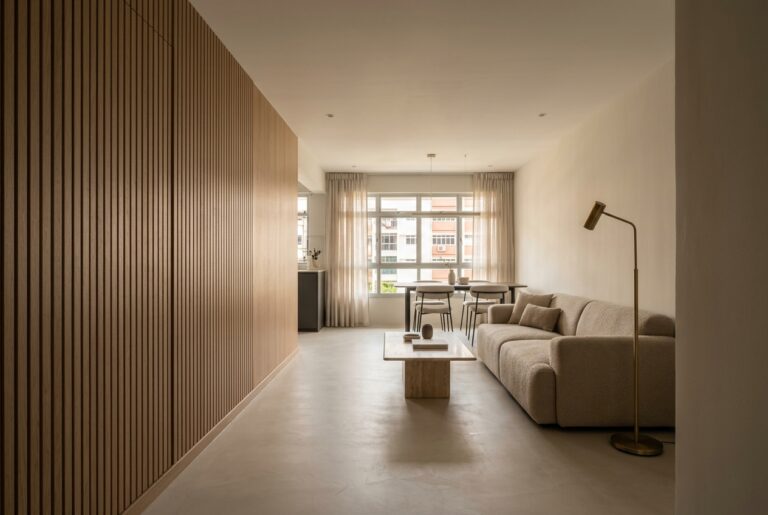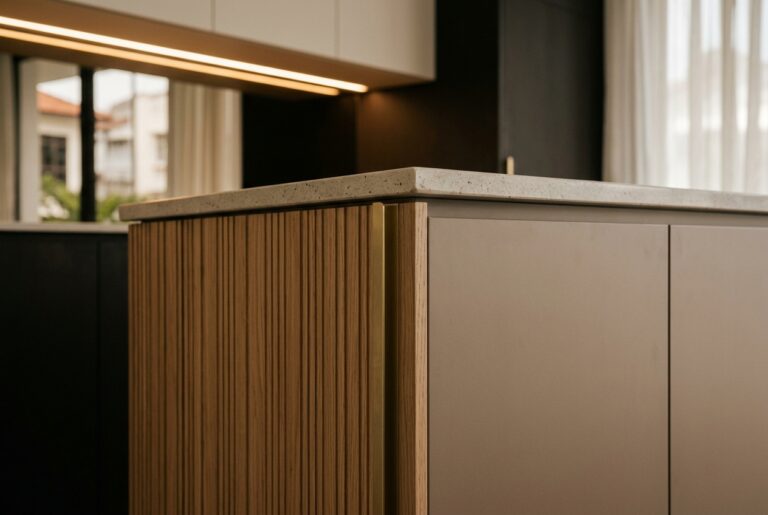
Condominium renovation in Singapore is priced differently from HDB work, and not only because the units are larger. The rules are set by a management corporation rather than by HDB, the buildings have their own constraints, and the specification expectations are usually higher.
As a working figure for 2026, a three-bedroom condominium typically costs between $60,000 and $100,000 to renovate. The band is wide because the single biggest variable is whether the unit is a new launch or a resale.
New launch versus resale
A new condominium is handed over finished: flooring laid, bathrooms complete, kitchen cabinetry and appliances installed. Renovating it is mostly additive, meaning carpentry, feature work, lighting and window treatments.
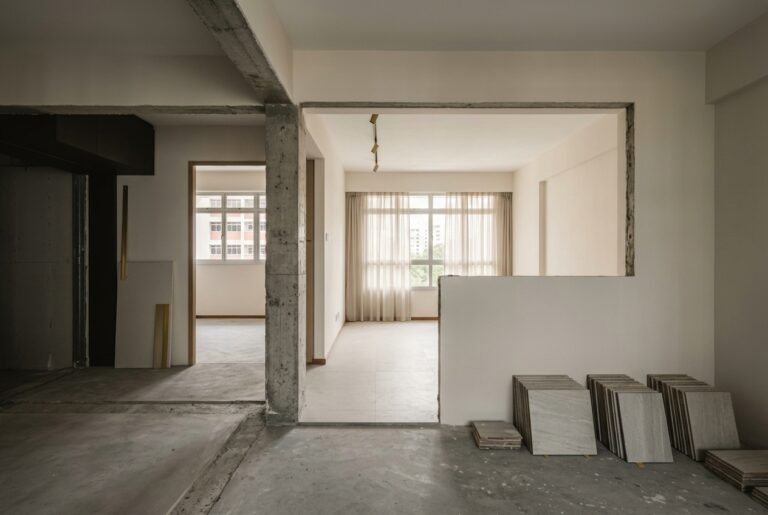
A resale unit is the opposite. Before you add anything, you are removing a previous owner’s decisions, which means hacking, disposal, waterproofing and making good. Market guides for 2026 put a new three-bedroom in roughly the $32,000 to $68,500 range and an equivalent resale unit at roughly $60,400 to $84,100, a gap of $20,000 to $50,000 that is almost entirely demolition, wet works and reinstatement.
| Unit | New launch | Resale |
|---|---|---|
| 1 to 2 bedroom | $20,000 to $45,000 | $40,000 to $65,000 |
| 3 bedroom | $32,000 to $70,000 | $60,000 to $100,000 |
| 4 bedroom and above | $55,000 to $110,000 | $90,000 to $180,000 |
Market ranges as at August 2026, drawn from published Singapore cost guides. Penthouse, duplex and landed work sits outside these bands.
What the MCST adds to the process
In a condominium the management corporation, the MCST, controls anything that touches common property or the building structure. Renovation approval is a formal application, not a courtesy notice.
What you will be asked for
- A completed renovation application form.
- Your contractor’s details, including BCA licence information where applicable.
- Proposed floor plans and a scope of works.
- An indemnity letter and, commonly, contractor insurance.
- A refundable security deposit.
What it costs
Refundable MCST renovation deposits in 2026 commonly range from about S$1,000 to S$10,000 depending on the development, plus a smaller non-refundable administrative or permit fee typically around S$200 to S$500. The refundable portion is the MCST’s protection against damage to common property: scratched lift panels, cracked corridor tiles, stained lobby floors. Repair costs are deducted before the balance is returned.
MCST committees commonly respond within five to ten working days, so build that into your programme rather than assuming same-week approval.
Ask for the house rules before you design, not after. Individual developments impose their own restrictions: permitted working hours, lift booking windows, no wet works after a certain hour, restrictions on hacking, limits on changing external-facing elements, and rules about which service lift the debris goes down. A layout designed without them is a layout that gets revised.
What typically requires written MCST approval
- Hacking or altering any wall.
- Bathroom waterproofing and any works affecting the floor slab.
- Relocating plumbing points.
- Electrical upgrades beyond the standard provision.
- Changing floor finishes, particularly from tile to timber, where acoustic transmission to the unit below is a concern.
- Anything visible from outside the unit, including window film, grilles and balcony treatments.
Where condo budgets go that HDB budgets do not
Ceiling height and services
Condominium units frequently have higher ceilings and concealed ducting, which makes false ceiling and bulkhead work both more visible and more expensive. Full-height joinery to a three-metre ceiling is not the same price as the same run in a flat.
Glass and facade
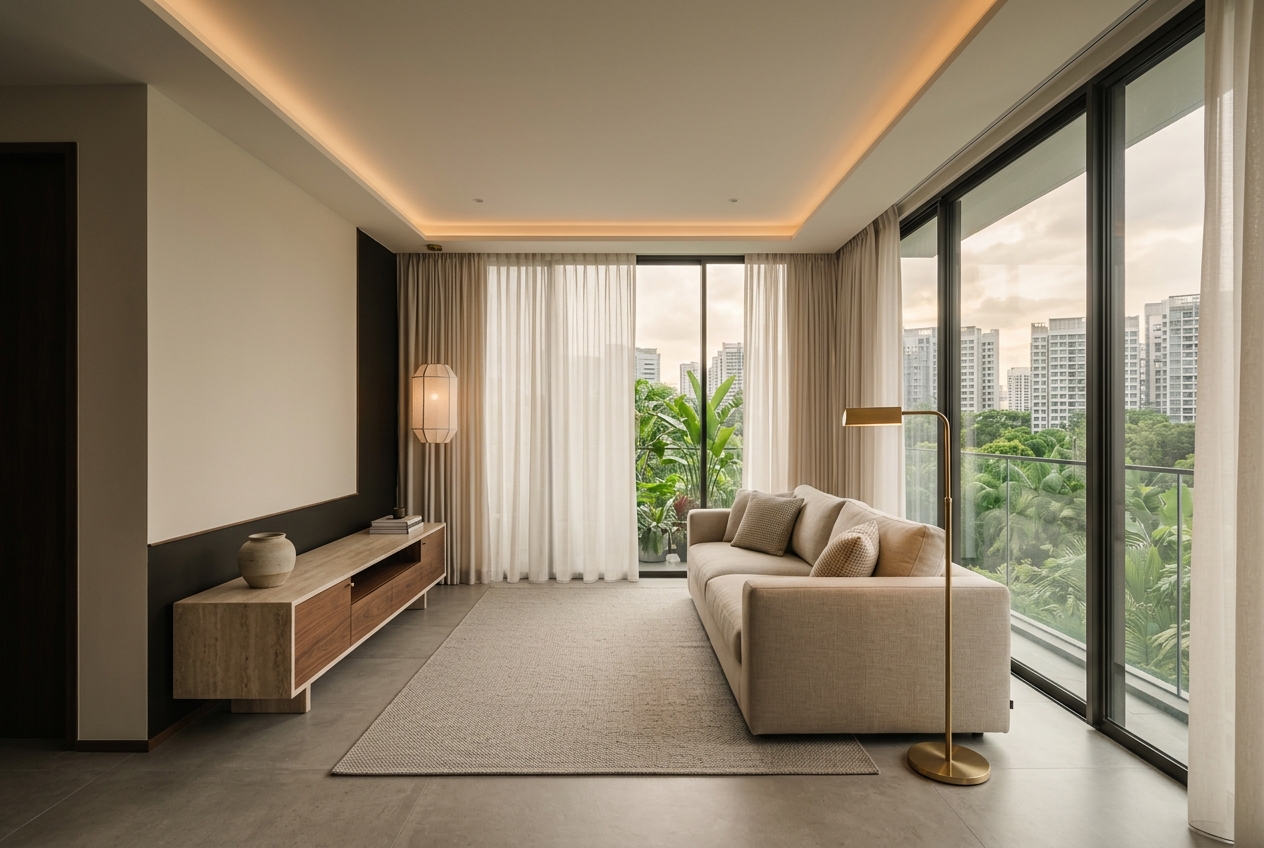
Floor to ceiling glazing is beautiful and thermally demanding. Blinds, curtains and film are a real budget line in a condominium, not an afterthought, and west-facing units in particular need them specified rather than added later.
Balconies and outdoor areas
Balcony flooring, external-grade joinery and outdoor lighting all cost more per square foot than their interior equivalents, and are usually the most restricted items in the house rules.
Acoustics
Neighbours are above and below as well as beside. Acoustic underlay, denser partition build-ups and solid-core doors are common specification upgrades in condominium work.
Access and logistics
Lift bookings, protection of common areas, restricted delivery hours and longer haulage distances all add labour hours. On a large unit this line is not trivial.
Where the money goes, proportionally
| Trade | Typical share of a condo budget |
|---|---|
| Carpentry and joinery | 30 to 40% |
| Hacking, masonry, tiling and wet works | 12 to 22% (higher on resale) |
| Ceiling, partitions and plastering | 8 to 14% |
| Electrical, lighting and data | 7 to 12% |
| Glass, doors and window treatments | 6 to 12% |
| Painting | 3 to 6% |
| Sanitary ware and fittings | 4 to 9% |
| Preliminaries, protection, haulage, MCST fees | 4 to 8% |
Five ways to control a condominium budget without it looking like it
- Keep the wet areas where they are. Moving a bathroom in a condominium is the most expensive decision available to you.
- In a new launch, keep the developer’s flooring. It is usually decent, and overlaying it buys very little visually while costing a great deal.
- Concentrate joinery. One superbly detailed run in the living area outperforms built-ins in every room.
- Specify window treatments early. Priced at the end, they get cut. Priced at the start, they get designed in.
- Spend on lighting. Layered lighting changes how an apartment reads at night more than any material choice, and it is comparatively inexpensive at first fix.
Room by room, what a three-bedroom typically absorbs
| Area | New launch | Resale | Main drivers |
|---|---|---|---|
| Living and dining | $10,000 to $22,000 | $16,000 to $32,000 | Feature joinery, ceiling and cove, lighting, window treatments |
| Kitchen | $8,000 to $20,000 | $16,000 to $32,000 | Carpentry length, countertop, appliances, whether anything wet moves |
| Master bedroom and ensuite | $7,000 to $16,000 | $14,000 to $26,000 | Wardrobe run and finish, bathroom hacking and waterproofing |
| Two bedrooms | $5,000 to $12,000 | $8,000 to $18,000 | Wardrobes, flooring, painting |
| Common bathroom | $2,000 to $6,000 | $7,000 to $14,000 | Full strip-out, waterproofing, tiling, sanitary ware |
| Balcony and entry | $2,000 to $8,000 | $4,000 to $12,000 | Flooring, storage, external-grade materials, MCST restrictions |
The pattern is consistent: in a new launch you pay for what you add, and in a resale you pay twice, once to remove and once to replace.
How long a condominium renovation takes
Add the MCST approval window to the front of any programme. A typical sequence looks like this.
- Design and specification: four to eight weeks, longer than an HDB equivalent because there is usually more of it.
- MCST application and approval: commonly five to ten working days once submitted, but submit only when the drawings are final, because a revised scope means a revised application.
- New launch, additive works: six to ten weeks on site.
- Resale, full strip-out: twelve to eighteen weeks on site.
- Defects and adjustment: one to three weeks after handover.
Restricted working hours, lift booking windows and limits on debris removal all reduce the number of productive hours per day compared with an HDB block. That is a real programme effect, not a contractor excuse.
The insurance and indemnity part nobody reads
Most MCSTs require your contractor to carry public liability insurance and to sign an indemnity for damage to common property, and many require proof before the renovation permit is issued. Two practical implications for you.
First, ask for the certificate of insurance and check the cover period spans your entire programme, not just the first month. Second, understand that the MCST deposit is your money at risk: if the contractor damages a lift panel and does not settle it, the repair comes out of the deposit that was paid in your name. Agreeing in your own contract who bears the cost of common-property damage is a five-minute conversation that occasionally saves several thousand dollars.
Acoustics: the constraint that only shows up after you move in
Condominium living puts neighbours above and below as well as beside you, and impact noise travels through slabs far more readily than airborne noise travels through walls. This is why many developments restrict changing tiled floors to hard timber, and why the restriction is usually about the underlay rather than the timber itself.
If you are changing floor finishes, ask what acoustic underlay is specified and whether it meets your development’s requirement. It is a modest cost at installation and impossible to add afterwards.
Common questions
Why is my condo quotation higher than an HDB one for the same square footage?
Higher ceilings, more glass, longer haulage, MCST requirements, acoustic build-ups and generally higher specification. The trades are the same; the quantities and the constraints are not.
Can I hack walls in a condominium?
Non-structural walls, usually yes, with written MCST approval. Structural elements, no. The MCST will typically require drawings and may require a professional engineer’s input depending on the development and the scope.
Is the MCST deposit refundable?
The security deposit is refundable, less the cost of any damage to common property. The administrative or permit fee normally is not.
How long does a condo renovation take?
A new launch with additive works only, commonly six to ten weeks. A resale unit with full hacking and wet works, commonly twelve to eighteen, plus the MCST approval window before it.
The summary
Budget $60,000 to $100,000 for a typical three-bedroom, expect a resale unit to cost noticeably more than a new launch for the same finished result, and get the MCST house rules in hand before the design is fixed rather than after.
Figures in this article are Singapore market ranges as at August 2026 and are not a quotation. Verify HDB requirements against HDB’s own renovation guidelines before committing to any scope.