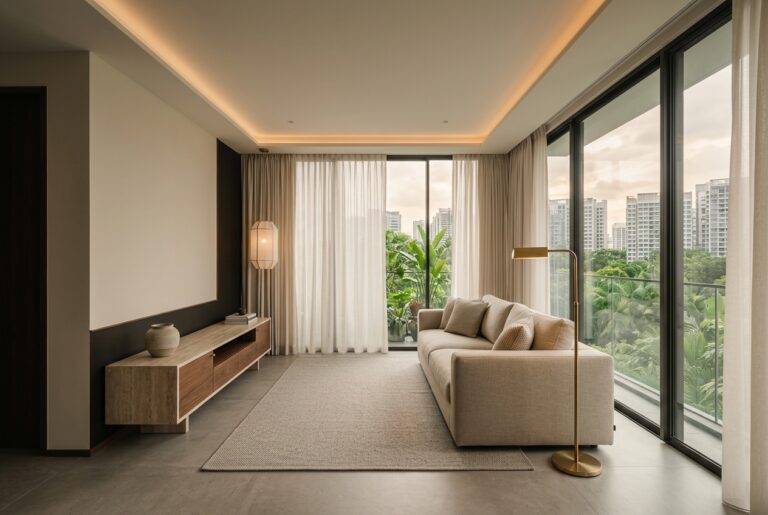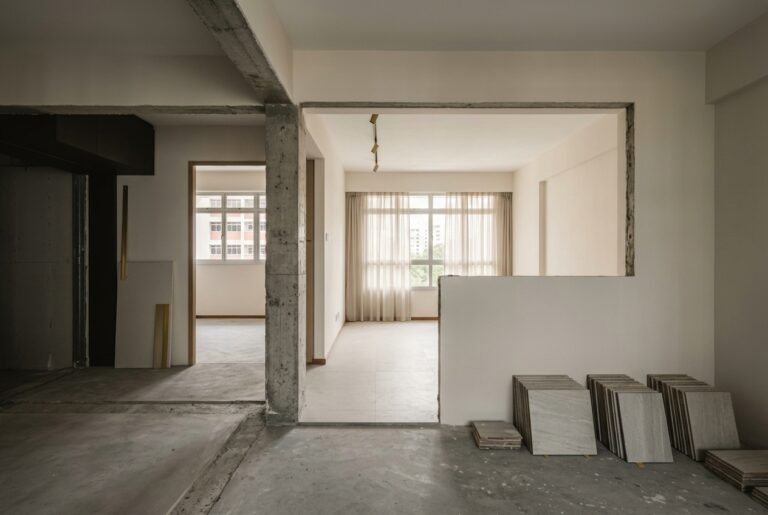
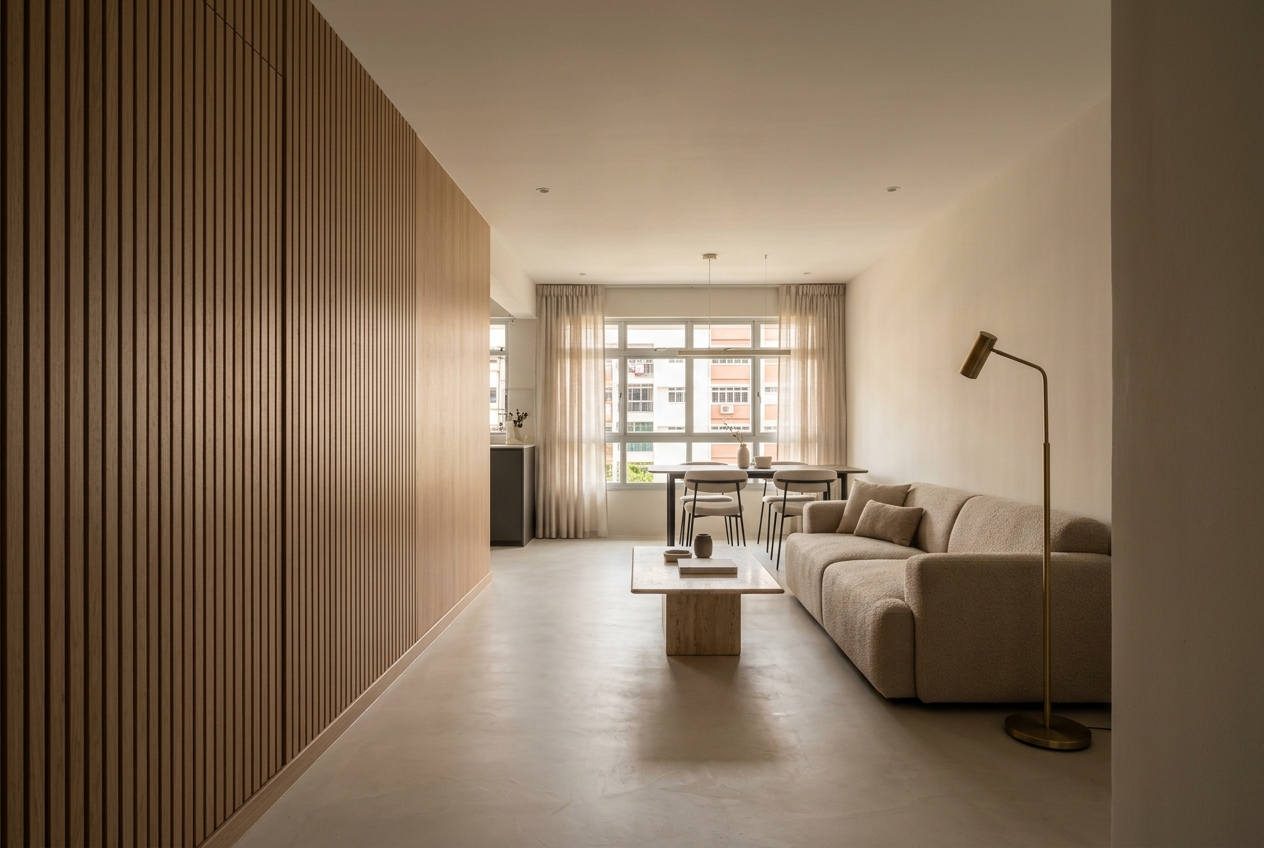
It is the first question every BTO owner asks, and the honest answer is a range rather than a number. For a 4-room flat collecting keys in 2026, most renovations land somewhere between $40,000 and $60,000. Below that you are furnishing rather than renovating. Above it you are usually buying more carpentry, more wet works, or better materials, not a better flat.
The widest published data set on real 4-room BTO projects, Qanvast’s 2026 round-up, shows completed jobs from $27,000 to $145,000, with an average projected in the $51,000 to $61,800 band. That spread of more than five times is not sloppy pricing. It is the difference between a flat that keeps its builder finishes and one that gets rebuilt from the screed up.
This guide breaks the budget into the parts a quotation is actually made of, tells you which line items move and which do not, and gives you the four decisions that quietly decide whether you are a $42,000 project or an $85,000 one.
The short answer, by scope
A 4-room BTO is roughly 90 square metres of brand new, defect-free space. That is the important part: unlike a resale flat, you are not paying to undo anyone else’s decisions. Almost the entire budget goes into adding things.
| Scope | Typical 2026 range | What that buys |
|---|---|---|
| Light | $25,000 to $38,000 | Keep the builder floor and doors. Kitchen and wardrobe carpentry, basic electrical, painting, minimal false ceiling. |
| Standard | $40,000 to $60,000 | Full carpentry across kitchen, wardrobes and TV console. Feature wall, cove lighting, quartz top, upgraded sanitary ware, some tiling. |
| Extensive | $65,000 to $95,000 | Overlaid or replaced flooring, reconfigured layout, spray finishes, glass partitions, full false ceiling, designer lighting. |
| High specification | $100,000 and up | Stone, veneer and 2-pac throughout, custom joinery in every room, integrated appliances, home automation. |
Ranges are market figures as at August 2026, cross-checked against published 2026 cost guides and Qanvast’s completed-project data. They are not a quotation for your flat.
Where the money actually goes
If you strip the marketing off a renovation quotation, a 4-room BTO breaks down remarkably consistently. Carpentry and wet works together are usually more than half the total, and everything else fights over the remainder.
| Trade | Typical share | Standard-scope 4-room |
|---|---|---|
| Carpentry (kitchen, wardrobes, console, feature joinery) | 30 to 40% | $14,000 to $22,000 |
| Masonry, tiling and wet works | 10 to 18% | $4,000 to $10,000 |
| Electrical and lighting points | 6 to 10% | $2,500 to $5,500 |
| Ceiling, partitions and plastering | 7 to 12% | $3,000 to $7,000 |
| Painting | 3 to 6% | $1,500 to $3,000 |
| Glass, aluminium and doors | 4 to 8% | $2,000 to $5,000 |
| Sanitary ware and kitchen fittings | 4 to 8% | $2,000 to $5,000 |
| Air conditioning | 4 to 7% | $2,500 to $4,500 |
| Haulage, protection, cleaning, permits | 2 to 4% | $1,000 to $2,500 |
The rule that predicts your budget: count the linear feet of built-in carpentry you want, multiply by your finish rate, and you will be within about 15% of the carpentry line before a designer has drawn anything. Everything else in a BTO is comparatively fixed.
Carpentry is the budget
Custom carpentry is priced per foot run, meaning per linear foot of cabinetry measured along the wall, not per square foot of door face. In 2026 a practical baseline for moisture-resistant plywood with a quality laminate finish and soft-close hardware sits around $180 to $250 per foot run, with sliding wardrobes and kitchen islands sitting higher.
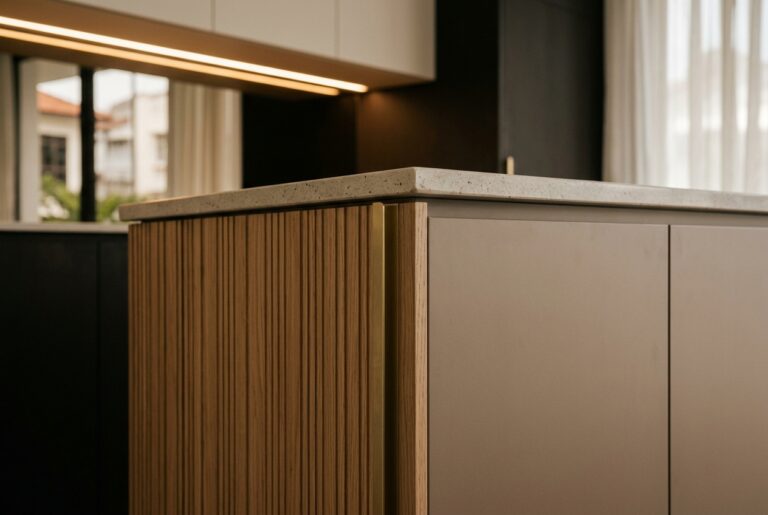
Two things push that rate up fast. Finish is the first: wood veneer typically adds around 30% over laminate, and spray finishes (2-pac, Duco, PU) around 45%, because they are done off-site in a paint booth and cannot be touched up on a Tuesday afternoon. Depth and height are the second: a full-height wardrobe to a 2.6m ceiling costs meaningfully more than a 2.1m one, because it is more sheet material and more hardware.
For a 4-room BTO with a full kitchen, three wardrobes, a TV console and a shoe cabinet, total carpentry commonly lands between $12,000 and $25,000. That single line explains most of the gap between two quotations that look otherwise similar.
What the per-foot-run rate usually excludes
- Countertops. Quartz, sintered stone and solid surface are priced by the slab or running foot, separately.
- Internal accessories: pull-out baskets, tall pantry mechanisms, internal drawers, integrated bins.
- Cabinet lighting and its wiring.
- Appliances, including hob, hood, oven and fridge, unless the quotation says otherwise.
When you compare two quotations, compare the exclusions before you compare the totals. A $16,000 carpentry line that excludes countertops and accessories is not cheaper than an $19,500 one that includes them.
The kitchen is the most expensive room
In a 4-room BTO the kitchen usually absorbs a quarter to a third of the whole budget on its own. A well specified kitchen with laminate carpentry, a quartz countertop, standard wall tiling and a decent sink and mixer typically lands between $12,000 and $16,000 before appliances.
The costly decisions inside a kitchen are rarely the ones people worry about. Cabinet colour is free. What is not free: extending the countertop into an island (structure, top, and often power below), moving the sink or hob away from the developer’s stack, tiling floor to ceiling instead of to the underside of the wall cabinets, and choosing a stone with a book-matched or mitred edge.
What a BTO does not need, and is often sold anyway
A new flat arrives with sound floor tiles or vinyl, level walls, working windows, a compliant electrical distribution board and a bathroom that already meets HDB’s waterproofing standard. Anything that replaces those is a preference, not a necessity, and should be priced as one.
- Full hacking of bathroom finishes. HDB states that newly built flats have a 3-year restriction period for the removal of wall and floor finishes in bathrooms and toilets. In a BTO, that decision is usually not yours to make in year one anyway.
- Overlaying the entire floor. Overlaying costs money, raises the floor level, and can create a lip at door thresholds. Worth doing if you hate the builder tile. Not worth doing by default.
- Full false ceiling everywhere. Ceiling is priced by area. A cove over the living and dining zones does 90% of the visual work of a whole-flat drop ceiling at a fraction of the cost, and keeps ceiling height in the bedrooms.
- Feature walls in every room. One well made feature wall reads as considered. Four read as a showroom.
The four decisions that move your number
1. How much is built in versus bought loose
Built-in joinery is the single largest lever. A loose wardrobe from a retailer costs a fraction of a built-in one and can move house with you. A built-in one fits the wall exactly, has no dust gap on top, and is worth paying for where it earns that: the kitchen, the master wardrobe, and any awkward corner. Everywhere else, loose furniture is a legitimate design decision, not a compromise.
2. Finish grade
Laminate, veneer and spray finish look different at 300mm and nearly identical at three metres. Spend the finish premium on the surfaces people touch and stand next to, and keep laminate on the interiors, the top boxes and the storerooms.
3. Whether you move anything wet
Plumbing points are where hidden cost lives. Moving a sink, adding a second bathroom floor trap, or relocating a washing machine involves floor levels, falls and waterproofing, and it is the one category where a cheap solution shows up as a problem two years later. HDB publishes specific guidelines for water and sanitary plumbing works, and the work must be done by a licensed plumber where required.
4. How early you finalise
Changes made on a drawing cost nothing. The same change made after the carpenter has cut sheet material costs the material plus the labour plus the delay. The most reliable way to protect a BTO budget is to make decisions before site starts, and then hold them.
Budgeting beyond the renovation quotation
The renovation contract is not the whole spend. Set aside for the items that arrive on separate invoices, because they are what turn a $48,000 renovation into a $62,000 move-in.
- Appliances: hob, hood, oven, fridge, washer, dryer.
- Air conditioning, if quoted separately.
- Loose furniture, mattresses and curtains or blinds.
- Lighting fixtures, where the quotation covers points and not fittings.
- A contingency. Ten percent of the contract sum is a sensible number for a BTO, and you will usually spend some of it.
Payment structure matters more than the headline price. Expect a deposit in the region of 10 to 20% and the balance released against completed stages, with a final retention held until you have inspected the work. A contractor asking for half the contract value before anyone has been on site is telling you something about their cash position.
How to compare two quotations properly
- Normalise the carpentry. Convert both to a rate per foot run and check the finish, the carcass material and the hardware brand.
- Count the electrical points. Two quotations differing by $3,000 often differ by twenty points and a distribution board upgrade.
- Read the exclusions page. That is where a quotation is really written.
- Check the tiling area. Floor to ceiling versus floor to cabinet is a large quantity difference disguised as a specification detail.
- Ask what happens if something changes. A firm that has a written variation-order process will not surprise you in week six.
Common questions
Is $30,000 enough for a 4-room BTO?
Yes, if you keep the builder flooring, limit carpentry to the kitchen and one or two wardrobes, skip the false ceiling outside the living area and choose laminate throughout. Completed projects at and below that figure exist. They read as calm and restrained rather than under-budget, provided the design is planned for that budget from day one instead of value-engineered down to it.
Why is my quotation higher than the averages here?
Usually one of three reasons: an unusually long run of carpentry, a spray or veneer finish specified across the flat, or wet works that move plumbing. Ask your designer to isolate those three lines and you will find the difference.
Do interior design firms cost more than contractors?
The trade prices underneath are broadly the same. What differs is what sits on top: drawings, specification, sourcing and site coordination. Whether that is worth paying for depends on how much of it you intend to do yourself.
The honest summary
Budget $40,000 to $60,000 for a standard 4-room BTO renovation in 2026, add ten percent contingency, and understand that carpentry length and finish grade will decide where inside that band you land. A well planned $45,000 flat will look better than a badly planned $70,000 one, every single time.
Figures in this article are Singapore market ranges as at August 2026 and are not a quotation. Verify HDB requirements against HDB’s own renovation guidelines before committing to any scope.