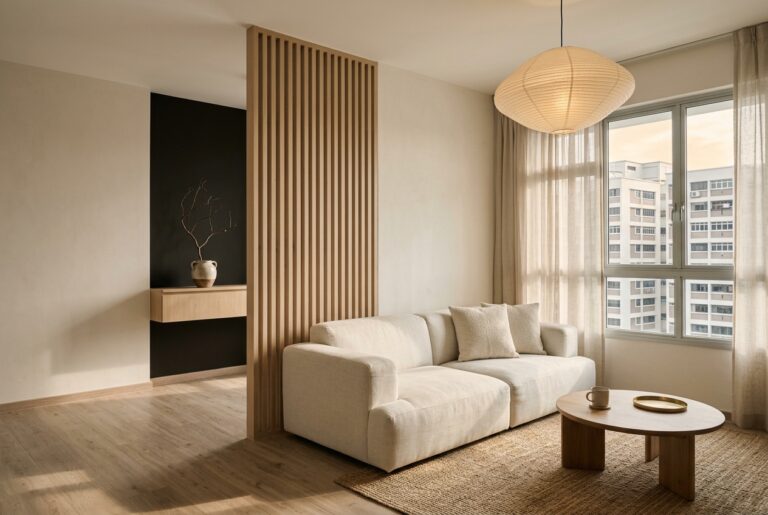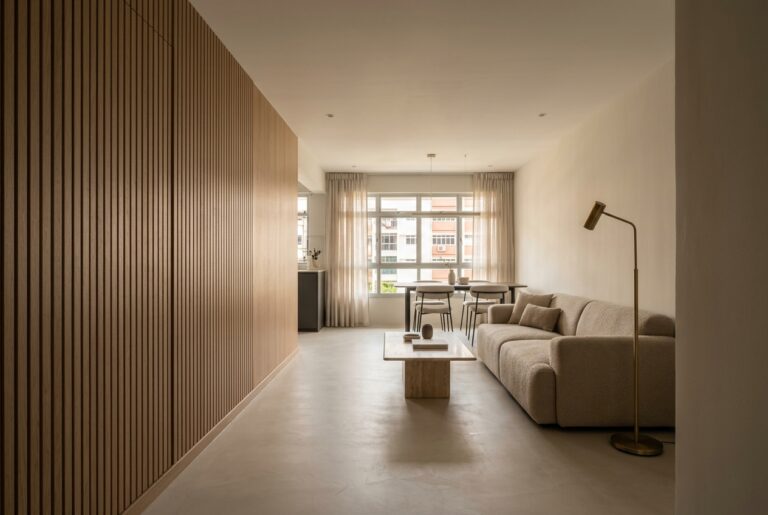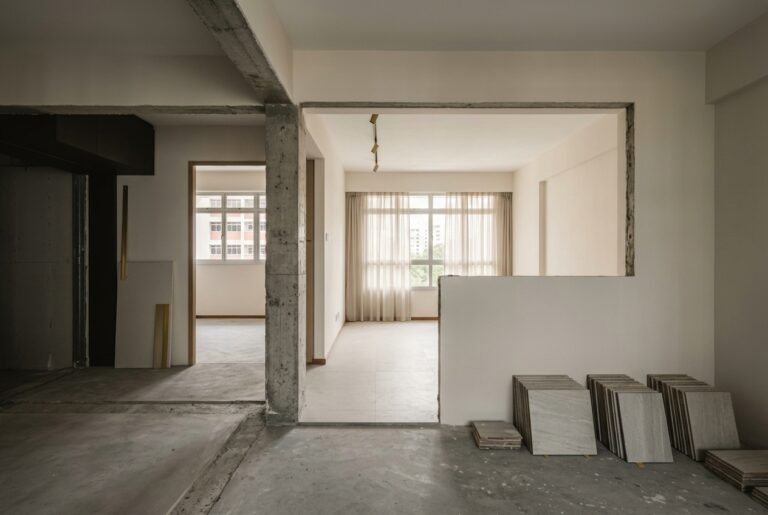
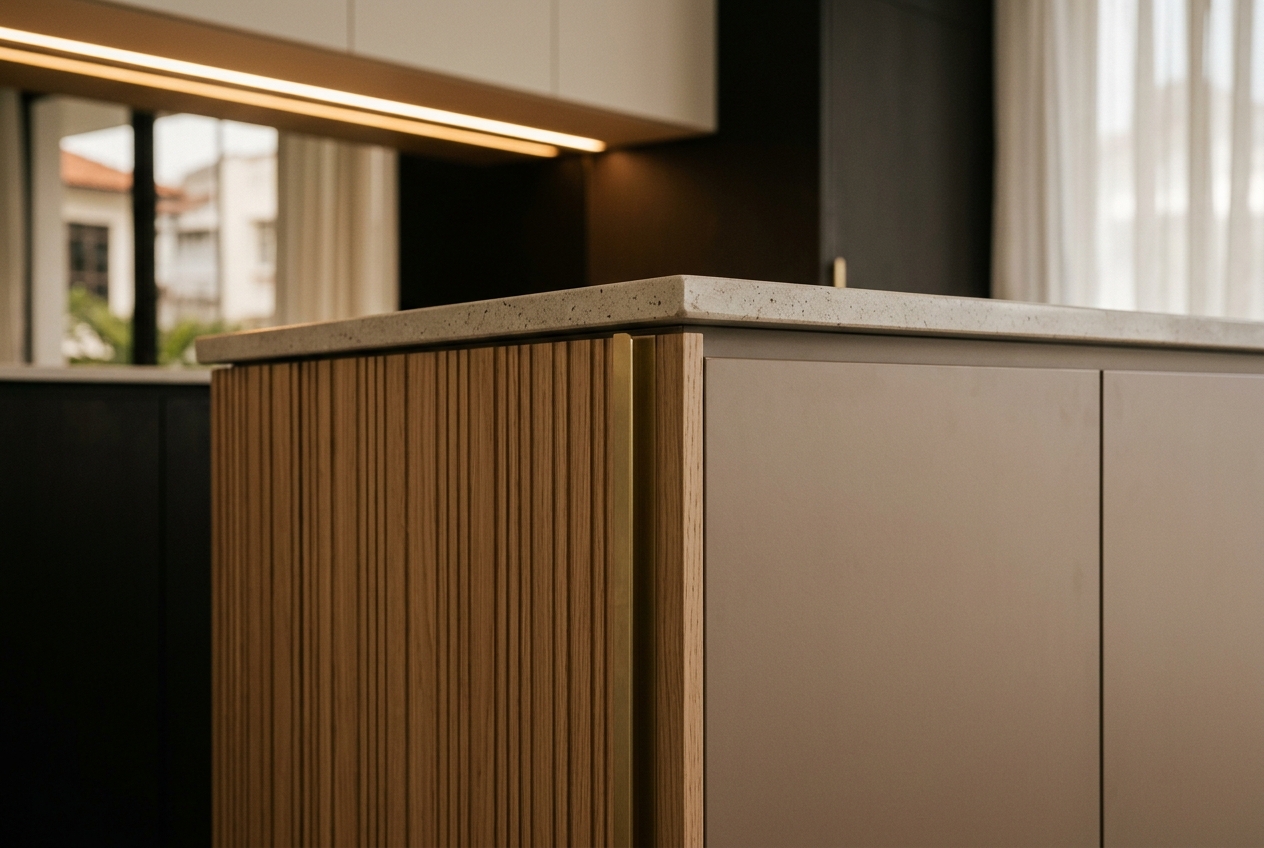
Carpentry is the largest single line in almost every Singapore renovation, and the least understood. It is also the line where two quotations that look $4,000 apart are frequently not quoting the same thing at all.
Here is how it is priced, what the rate includes, what it almost never includes, and how to buy it well.
How carpentry is priced: the foot run
Custom carpentry in Singapore is quoted per foot run, abbreviated pfr. That means per linear foot measured along the wall, not per square foot of cabinet face. A three-metre kitchen run is about ten feet run. A 2.4m wardrobe is about eight.
For 2026, a practical baseline for quality moisture-resistant plywood, a standard laminate finish and reliable soft-close hardware is $180 to $250 per foot run. Published 2026 guides put the fuller market spread at roughly $130 to $450 per foot depending on the piece, with swing-door wardrobes and kitchen base cabinets near the lower end and sliding wardrobes and kitchen islands near the top.
| Item | Typical 2026 rate (pfr) |
|---|---|
| Kitchen base cabinets, laminate | $200 to $320 |
| Kitchen wall cabinets, laminate | $180 to $280 |
| Swing-door wardrobe, laminate | $200 to $320 |
| Sliding-door wardrobe, laminate | $250 to $400 |
| Kitchen island | $250 to $450 |
| TV console and feature joinery | $180 to $350 |
| Shoe cabinet and entryway storage | $180 to $300 |
Market ranges as at August 2026. Height, depth, internal configuration and site conditions all move these figures.
What actually changes the rate
Finish
This is the biggest multiplier. Working from a laminate baseline, wood veneer typically adds around 30% and spray finishes (2-pac, Duco, PU) around 45%. Spray is more expensive because it is done off site in a controlled booth, requires more preparation, and cannot be touched up casually on site.
Height
Full-height joinery to a 2.6m ceiling uses more sheet material and more hardware than a 2.1m unit, and it needs a top box or a filler detail. Going full height is usually the right decision for storage and for how the room reads, but it is not a free upgrade.
Carcass material
Moisture-resistant plywood is the sensible default in Singapore’s humidity, particularly in kitchens and near bathrooms. Cheaper boards exist and cost less, and they are the most common silent substitution in a low quotation. Ask what the carcass is, in writing.
Complexity
Curves, mitred corners, integrated handles, fluted or slatted faces, glass fronts and lit niches all add fabrication time. A flat door is cheap. A handleless J-pull with an integrated LED reveal is not.
Hardware
Hinges, runners and lift systems from established brands cost more and last longer. This is the least glamorous upgrade in a renovation and probably the one you will notice most, ten years in.
What the rate usually excludes
These are the four exclusions that turn a comfortable carpentry budget into an uncomfortable one. Check every quotation for all four.
- Countertops. Quartz, sintered stone and solid surface are priced separately, by slab or running foot. Edge profile, mitred returns and any upstand are extra again.
- Internal accessories. Pull-out baskets, internal drawers, tall pantry mechanisms, cutlery inserts, integrated bins and corner carousels are typically itemised on top.
- Cabinet lighting. Strip lighting under wall cabinets or inside wardrobes, plus the wiring and driver, usually sits in the electrical scope or as an add-on.
- Appliances. Hob, hood, oven, fridge and sink are usually yours to supply, and the cut-outs need to be confirmed before fabrication.
What a typical 4-room flat spends
Total carpentry for a 4-room HDB flat with a full kitchen, three wardrobes, a TV console and entryway storage commonly lands between $12,000 and $25,000. That single range explains most of the difference between a $40,000 renovation and a $60,000 one.
| Item | Typical size | Laminate estimate |
|---|---|---|
| Kitchen, base and wall | 10 ft base + 8 ft wall | $3,500 to $6,000 |
| Master wardrobe | 8 ft, full height | $1,800 to $3,200 |
| Two bedroom wardrobes | 6 ft each | $2,400 to $4,200 |
| TV console and feature wall | 8 ft | $1,600 to $3,000 |
| Entryway and shoe storage | 4 ft | $800 to $1,400 |
| Countertop, quartz | 10 ft | $1,200 to $2,800 |
Where to spend and where to save
Worth paying for
- Moisture-resistant carcass throughout, without exception in kitchens and bathrooms.
- Good hinges and runners, particularly on drawers that get daily use.
- Full-height joinery in the kitchen and master wardrobe, which removes the dust gap and buys real storage.
- A better finish on the two or three surfaces you stand next to every day.
Safe to save on
- Interiors. Nobody sees the inside of a wardrobe. A white laminate interior is not a compromise.
- Top boxes and storeroom joinery.
- Guest bedroom wardrobes, where loose furniture often does the same job for a fraction of the price.
- Feature joinery in rooms you use for an hour a day.
The most reliable saving is length, not specification. Removing eight feet of carpentry saves more than downgrading forty feet of it, and it does not show up as a cheaper-looking flat. Loose furniture is a legitimate design choice, not a budget failure.
Materials, in plain terms
The carcass
This is the box behind the door, and it is what decides whether your cabinetry is still square in eight years. Moisture-resistant plywood is the sensible default in Singapore, particularly in kitchens, bathrooms and anywhere near a service yard. Blockboard is used for some structural elements. MDF is stable and takes a spray finish beautifully but does not tolerate standing water. Chipboard or particle board is the cheapest option and the one most likely to swell at a cut edge.
The failure mode is always the same and always in the same place: the base of a kitchen cabinet under the sink, or the bottom shelf of a wardrobe against an external wall. Specify moisture-resistant material there without negotiating.
The finish
| Finish | Relative cost | Strengths | Watch for |
|---|---|---|---|
| Laminate | Baseline | Hard-wearing, huge range, easy to repair by replacing a door | Visible edging on cheaper grades, joint lines on long runs |
| Wood veneer | About +30% | Real timber grain, warm, ages well | Grain matching costs extra; fades in direct sun |
| Spray, 2-pac or PU | About +45% | Seamless, any colour, superb on curves and handleless fronts | Chips are hard to repair; dark colours show fingerprints |
| Acrylic or high gloss | Varies | Very reflective, makes small kitchens feel larger | Shows every mark under hard tropical light |
| Sintered stone or compact laminate fronts | High | Extremely durable, excellent for islands | Weight and cost; needs a stronger carcass |
Countertops
Quartz is the Singapore default for good reason: non-porous, consistent, and forgiving of daily use. Sintered stone is harder and handles heat better, at a higher price. Solid surface allows seamless joins and integrated sinks. Natural marble is beautiful and will stain; if you want it, want it knowingly.
The detail that costs money is the edge. A standard 20mm slab edge is cheapest. A mitred edge that reads as a thick 40mm or 60mm slab requires two pieces joined at 45 degrees, and it is one of the biggest visual upgrades available in a kitchen.
How to measure your own foot run
You can estimate your carpentry cost before anyone quotes you, and it takes fifteen minutes.
- Walk each room and measure, in feet, the horizontal length of every wall you want cabinetry against.
- Count wall cabinets separately from base cabinets. They are priced separately.
- Note the ceiling height, because full height and standard height are different rates.
- Add the lengths together for a total foot run.
- Multiply by your finish rate, using $180 to $250 for laminate.
- Add the countertop, the accessories and cabinet lighting separately.
If your resulting figure and a quotation are wildly apart, you now have a specific question to ask rather than a vague sense that something is expensive.
Hardware, and why it is the upgrade you will actually notice
Hinges, drawer runners and lift-up mechanisms are the moving parts of a kitchen, which means they are the parts that fail. Established hardware brands cost more per unit and are rated for far more cycles, and in a kitchen used three times a day that difference is measured in years rather than percentages.
Three specifics worth asking about: soft-close on every drawer and door rather than only the showpiece ones, full-extension runners so the back of a deep drawer is actually reachable, and the load rating on any drawer intended to hold pots or crockery.
Living with carpentry in 80% humidity
- Ventilate closed joinery. Wardrobes against external walls benefit from a small gap at the back and from not being packed solid.
- Wipe spills at the base of kitchen cabinets immediately. Standing water at a cut edge is the single most common cause of swelling.
- Check under the sink twice a year. A slow trap leak destroys a cabinet base long before you notice the smell.
- Keep dark spray finishes out of direct afternoon sun where you can, and clean them with a soft cloth rather than anything abrasive.
- Adjust hinges annually. Doors drift. Five minutes with a screwdriver keeps a kitchen looking new.
Questions to ask before you sign a carpentry line
- What is the carcass material, and is it moisture resistant?
- What is the finish, and on which faces?
- Which hardware brand, and is soft-close included on every door and drawer?
- Is the countertop included, and to what thickness and edge detail?
- Which internal accessories are in, and which are extra?
- Is cabinet lighting included, along with its wiring?
- Will I get an elevation drawing for each item before fabrication?
- What is the warranty on the carpentry, and what does it cover?
Common questions
Is built-in always better than loose furniture?
No. Built-in wins where the wall is awkward, where you need full height, and in the kitchen. Loose wins on cost, on flexibility, and on being able to take it with you.
How long does carpentry take?
Fabrication typically runs three to five weeks off site after the drawings are approved, with installation itself taking days. That is why changes after drawing approval are expensive.
Why is one quotation $6,000 cheaper for the same cabinets?
Usually the carcass, the hardware, or an excluded countertop. Occasionally all three.
Does spray finish last?
Done properly it looks superb and holds up well, but it chips harder to repair than laminate and shows fingerprints on dark colours. It is a considered choice, not automatically an upgrade.
The summary
Budget $180 to $250 per foot run for laminate, add roughly 30% for veneer and 45% for spray, expect $12,000 to $25,000 total on a 4-room flat, and read the exclusions before the total. Carpentry is where renovations are won or lost on value.
Figures in this article are Singapore market ranges as at August 2026 and are not a quotation. Verify HDB requirements against HDB’s own renovation guidelines before committing to any scope.