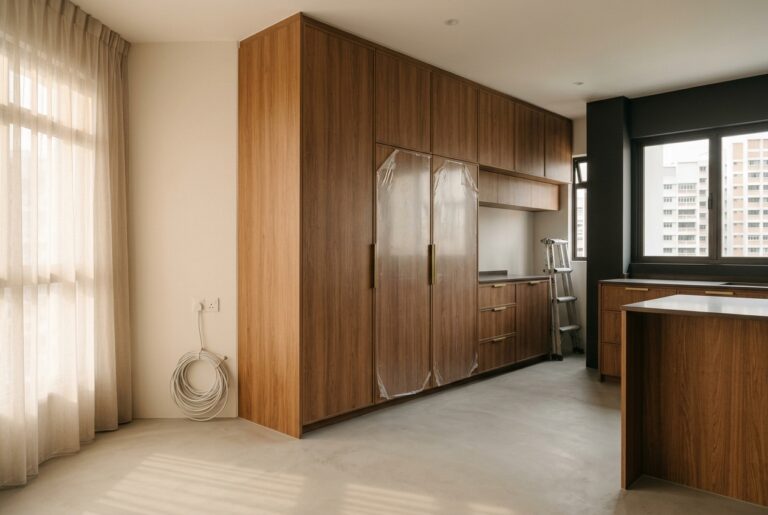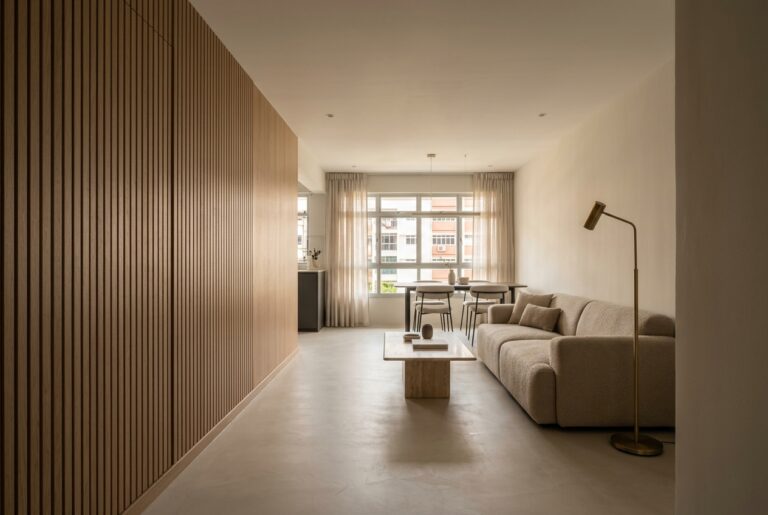

This is the question that decides the shape of your entire renovation, and it is usually answered badly, because it gets framed as a price comparison. It is not. Both routes hire the same tilers, the same carpenters and the same electricians, often literally the same people. What you are choosing is who holds the design, the specification and the coordination.
What each one actually does
| Renovation contractor | Interior design firm | |
|---|---|---|
| Primary role | Executes a scope of works | Defines the scope, then executes it |
| Design output | Basic layout, sometimes a 3D | Space planning, elevations, detailed drawings, material and lighting specification |
| You supply | The design decisions | The brief and the budget |
| Sourcing | Usually their standard range | Curated per project, with samples |
| Site coordination | Their own trades | Trades plus sequencing against the design intent |
| Best when | The scope is clear and mostly like-for-like | The layout, look or budget still has to be worked out |
The distinction is not quality, it is where the thinking happens. A good contractor executing a clear, well specified scope produces excellent work. The same contractor handed a vague brief will make a hundred small decisions on your behalf, on site, under time pressure, and the result will look like a hundred small decisions.
When a contractor is the right call
- You are replacing like for like. New kitchen in the same position, same worktop height, same layout.
- The scope is defined and you can hold it. You know your tile, your laminate code, your tap and your layout, and you will not change your mind in week four.
- You have time. Someone has to answer the site questions, and that someone is you.
- The project is small. A bathroom, a kitchen, a repaint plus a couple of wardrobes.
If that is your situation, hiring a design firm to project-manage a scope you have already fully defined is paying for a service you are not using.
When a design firm earns its fee
- The layout is not working and you do not know why. This is the most common and least admitted reason, and it is the one where design pays for itself.
- You have a look you want and cannot specify it. Reference images are a starting point, not a specification. The distance between an image you like and a materials schedule is exactly the work.
- The flat has a real constraint. An awkward column, a long dark corridor, a household shelter in the wrong place, a low beam, or a layout with three doors into one corner.
- The budget is tight and must be spent well. Counterintuitive but true: the tighter the budget, the more the sequence of decisions matters, because there is no room to fix mistakes by spending more.
- You do not have the hours. A renovation generates dozens of decisions a week. Someone answers them.
The money question, answered properly
Design services are usually built into the project cost rather than billed as a separate percentage, which is why comparing a designer’s total against a contractor’s total is misleading. Two things are usually true at once: the design route’s headline figure is higher, and the finished specification is not the same.
To compare fairly, you have to normalise:
- Carpentry rate per foot run, at the same finish and the same carcass material.
- Number of electrical and lighting points, not just their presence.
- Tiling area, floor to ceiling versus floor to cabinet.
- Inclusions: countertops, accessories, cabinet lighting, appliances, haulage, protection, final cleaning.
- The variation process, because unpriced changes are where a cheap quotation becomes an expensive project.
Do that, and the two numbers usually move a lot closer together than the cover page suggested.
What matters far more than the label
The strongest predictor of a renovation going well is not whether the company calls itself a contractor or a design studio. It is these:
- An itemised quotation. Every trade, with quantities and unit rates, never a single lump sum.
- Payment tied to completed stages, with a modest deposit and a retention held until final inspection.
- A named person on site. Ask who is coordinating your job and how many other jobs they are running that month.
- Accreditation and registration. CaseTrust-RCMA accreditation involves a standardised contract and a deposit bond. Check the firm’s business registration and, where the work requires it, that the specialist trades are BCA-approved or licensed.
- Completed work you can actually see. Photographs of finished homes, ideally in the flat type you own.
- Willingness to say no. A firm that tells you your budget does not match your brief before you sign is worth more than one that agrees to everything.
One payment rule worth writing down. Pay the registered company, against a proper tax invoice showing its UEN. A request to transfer to a personal account, PayNow a mobile number, or pay cash with no receipt is the point to stop, regardless of how good the design looks.
The hybrid that most people actually want
In practice, a large share of Singapore homeowners want something between the two: proper space planning and a specification they can trust, without paying for a full design service on rooms that only need painting.
That is a legitimate way to buy. Ask for design and detailing on the rooms that carry the flat, usually the living, dining and kitchen, and a straightforward execution scope on the rest. A studio that will not scope that way is telling you about its business model, not about your project.
What a design service is actually made of
“Design” is a vague word on a quotation. Here is what it should mean in deliverables, so you can check whether you are being given it.
| Deliverable | What it is | Why it matters |
|---|---|---|
| Space plan | Dimensioned layout with furniture and circulation | Proves the sofa, the dining table and the walkway all fit at the same time |
| Carpentry elevations | A drawn front view of every joinery item, with dimensions | This is what the carpenter builds from. Without it you are approving a mood board |
| Electrical and lighting plan | Every socket, switch, data point and light, positioned | The last free moment to move a point is before first fix |
| Materials schedule | Named finishes with codes, per surface | Removes substitution risk and lets you compare quotations honestly |
| Ceiling plan | Cove, bulkhead, drop levels and fixture positions | Ceiling is priced by area and detail, and changed cheaply only on paper |
| Sequenced programme | Trade by trade, week by week | Lets you see when a late decision becomes a delay |
If a firm calls itself a design studio but produces only a 3D visual and a price, you are buying a contractor with rendering software. That is not an insult, and it may be exactly what you need, but you should know which one you are paying for.
The third option people forget: design and build
Most Singapore interior firms are design-and-build: one contract, one party responsible for both the drawing and the execution. That single-contract structure is the reason it dominates here, because it removes the gap where a design says one thing and a builder prices another.
The alternatives exist and are worth knowing about. An independent designer who produces drawings for you to tender to contractors gives you price competition, at the cost of owning the coordination yourself. An architect is the right call for landed property, structural alteration or anything requiring statutory submission, and is generally over-specified for a flat. Buying design and build from one firm trades a little price transparency for a lot less risk of falling between two parties.
The ten questions to ask at a first meeting
- Who will be my day-to-day contact, and how many projects are they running this month?
- Will I get carpentry elevations and a materials schedule before fabrication?
- What is your payment schedule, and what triggers each stage?
- What retention do you hold, and when is it released?
- How are variations priced and recorded?
- What is the warranty, what does it cover, and what voids it?
- Which parts of my project are subcontracted, and to whom?
- Can I see two completed homes of the same flat type?
- What is your realistic handover date, and what is your buffer?
- What would you tell me not to spend money on?
The last question is the most revealing. A firm that cannot name a single thing you should skip is selling, not advising.
Warning signs, on both sides
From a contractor
- A lump-sum quotation with no quantities.
- A verbal promise that something is included.
- Reluctance to put the variation process in writing.
- Design decisions being made on site, on the day, without you.
From a design firm
- Beautiful visuals with no elevations behind them.
- A specification that changes quietly between the design and the build.
- A designer who agrees to every request without ever mentioning cost or programme consequences.
- No named site coordinator, or one who is unreachable for days.
The single most useful question in the whole process: “What is not included in this price?” Ask it in the first meeting and ask it again before you sign. The quality of the answer tells you more than any portfolio.
Common questions
Is an interior designer worth it for an HDB flat?
It depends entirely on how much unresolved thinking your project contains. For a like-for-like refresh, often no. For a flat where the layout, the storage or the light is the actual problem, that is exactly what the fee is buying.
Can I use a designer for drawings and a contractor to build?
You can, and it works when the drawings are detailed enough to build from and someone owns the site coordination. It fails when it becomes a way to shave cost, because the gaps between the two scopes become your problem to resolve, mid-build.
Do designers mark up materials?
Some quote materials at cost plus a stated coordination fee, some carry it inside the rate. Neither is wrong. Ask which one you are buying and get it in writing.
The summary
Hire a contractor when you already own the decisions. Hire a design studio when the decisions are the hard part. And whichever you choose, judge them on the itemised quotation, the payment schedule and the person who will be on site, because those three things predict the outcome better than the job title on the business card.
Figures in this article are Singapore market ranges as at August 2026 and are not a quotation. Verify HDB requirements against HDB’s own renovation guidelines before committing to any scope.